Why We're Not the Cheapest Tile Contractor in Arizona (and Why That's the Point)
I want to be upfront with you before you ever pick up the phone.
If you are shopping around and collecting three tile quotes, ours is probably not going to be the cheapest one you get. It might not even be the second cheapest. And I want to explain exactly why -- because the reason matters more than the number.
There are contractors in the Phoenix area who will quote your shower for thousands less than we will. I know, because homeowners show me their other bids all the time. And every time, I could match those numbers if I were willing to do what those contractors do. I am not. And after reading this, I think you will understand why.
This post is long on purpose. If you are about to spend five, ten, or twenty thousand dollars on a tile project, you deserve to know what you are actually paying for -- and what you are not paying for when a quote comes in suspiciously low.
The Race to the Bottom Is Real
The tile industry has a problem most homeowners never see. It is an incredibly easy industry to enter and an incredibly hard one to do well. Anyone can buy a wet saw at Home Depot, watch a few YouTube videos, print business cards, and call themselves a tile contractor by the weekend.
There are no state exams for tile installation. No practical test. Arizona requires a contractor license for jobs over $1,000, but the licensing test does not actually verify that you know how to build a waterproof shower or flatten a floor. It verifies you know the business rules.
The result is a market flooded with people competing on one thing and one thing only: price. And when an entire industry competes on price, the only way to win is to cut something out of the job. Homeowners do not always know what is being cut -- because the things that get cut are the things you cannot see once the last tile goes on the wall.
The Contractors Who Do Not Actually Exist
Before we talk about what gets cut from the job, let's talk about who is cutting it -- because some of the people quoting your project are not contractors at all. They are actors.
I do not mean that to be disrespectful. Some of them are genuinely good guys. Friendly, hardworking, well-intentioned people. But being a good guy does not make you a good tile installer. And being a good tile installer does not make you a legitimate business that can stand behind its work when things go sideways.
Here is the profile: no Arizona contractor license. No general liability insurance. No workers' compensation coverage. No history with the Registrar of Contractors (ROC). No website. No Google Business listing. No online reviews. No portfolio. No verifiable track record of any kind. Just a phone number, a pickup truck, and a price that undercuts every licensed contractor in the valley.
And it works -- until it does not.
When the shower leaks six months later, you call the number. It rings. Maybe it goes to voicemail. Maybe you get a text back saying they will come take a look. Then the texts stop. Then you are blocked. And now you are standing in a bathroom with water damage, no warranty, no recourse, and no way to find the person who built it. They have no ROC license to file a complaint against. They have no insurance to file a claim with. They have no business address. They do not exist -- and they never really did.
That is why we have everything in writing, in public, and on the record. ROC# 349493. Pull it up on the Arizona Registrar of Contractors website right now. Full general liability insurance. Workers' compensation on every crew member. A real website you are reading right now. A portfolio of finished work. Reviews from real homeowners. An Instagram, a Facebook, a YouTube, a TikTok -- all showing real projects with our name on them. If something ever goes wrong, you know exactly where to find us. We are not going anywhere.
What "Cheap" Actually Means on a Tile Job
When a quote is significantly lower than ours, it is almost never because that contractor found some clever efficiency we do not know about. It is because something on the list below is being skipped, substituted, or rushed. Let me walk through exactly what gets cut.
1. Real Waterproofing
This is the single biggest area where cheap quotes come from. A full waterproofing system -- Schluter Kerdi, HydroBlok, Laticrete Hydro Ban, or similar -- costs real money in materials and real time to install correctly. Our shower waterproofing alone can run several hundred dollars in materials on a single bathroom, before any tile is ever purchased.
What does a cheap contractor do instead? A few options, all of them bad:
- They rely on the tile and grout to be waterproof. It is not. Grout is cement. Cement absorbs water. Tile is waterproof, but the joints between them are not -- and the wall behind them definitely is not.
- They use a plastic vapor barrier behind cement board. This was an accepted method decades ago, but the membrane on the warm side of the wall is now known to trap moisture in the cavity and promote mold growth. TCNA no longer recommends it as a primary method in most assemblies.
- They brush a single thin coat of liquid waterproofer. Products like RedGard require two coats at a specific mil thickness to actually waterproof. One sloppy coat looks the same on top but fails a water test.
- They skip the shower pan system entirely and hope a drain flange and some silicone will be enough. It is not.
This is the cut you never see and never know about -- until two years later when your neighbor's ceiling below the shower starts to stain, or you pull up a tile to re-caulk and find black mold behind it. By then, the contractor is long gone and the repair costs more than the original job did.
2. Substrate and Floor Prep
Tile does not forgive a bad surface underneath it. If the concrete slab has a hump in the middle, you will feel it under your feet for the rest of your life. If the plywood subfloor flexes, your grout will crack within a year. If there is an old crack in the slab, it will telegraph through the new tile.
Real floor prep costs money. Self-leveling compound is expensive. Crack isolation membrane is expensive. Grinding down a high spot on a slab takes hours. Shimming a plywood subfloor to meet TCNA deflection limits takes real carpentry.
A cheap contractor tiles over whatever is there. If the floor is uneven, they feather thinset. If the slab is cracked, they tile right over it. If the subfloor flexes, they tile anyway and hope for the best. The homeowner finds out later when grout starts cracking in a straight line across the room -- right over the slab crack that was never addressed.
We grind, we self-level, we install crack isolation membrane where it is needed, and we reinforce subfloors before we ever open a box of tile. It is the least exciting part of the job and the most important part of the job.
3. The Materials We Actually Use
Here is a dirty secret of the cheap end of the industry: contractors will quote you premium materials and install whatever is on the shelf at the supply house that morning. Homeowners almost never notice, because one bag of white thinset looks like another.
On every Level Up Tile project, we use:
- Schluter All-Set thinset. A single premium polymer-modified mortar rated for every application from natural stone to large-format porcelain. Costs significantly more than a bag of generic thinset from a big-box store.
- Mapei grout on every project. Stain-resistant, color-consistent, and warranted by the manufacturer when installed to spec.
- Mapei Mapesil T Plus 100% silicone at every change of plane, color-matched to the grout. Not cheap caulk that yellows and cracks in a year.
- Schluter Kerdi membrane on every shower pan. HydroBlok foam boards on every shower wall. FloFX drains. Every single time.
- Laticrete penetrating sealers for natural stone and porous tile.
- Tile sourced through our trade partners at The Tile Shop, Arizona Tile, Emser Tile, and Floor & Decor. Real brands. Real warranties.
A cheaper contractor can save real money by buying mystery-brand thinset by the pallet, using the cheapest grout on the shelf, skipping the silicone at change-of-plane joints, and pushing you toward whatever tile has the highest margin for them. The finished job looks identical at move-in. It does not stay identical.
4. Labor, Skill, and Time
The last big variable is how much actual human time goes into the project. A shower that takes us 7 to 10 days to build correctly is being built by other crews in 3 to 4 days. How?
- They are not back-buttering tile, so coverage is at 40 to 50 percent instead of the 95 percent the standard requires.
- They are not using leveling clips, so lippage is whatever the eye can tolerate.
- They are not waiting for thinset to cure before grouting. They are not waiting for grout to cure before sealing. They are not waiting for sealer to cure before handing back the bathroom.
- They are not mitering outside corners. They are slapping a piece of bullnose trim on the edge, or worse, using plastic corner trim that looks cheap the day it goes up and worse every year after.
- They are running three or four jobs at once with one installer splitting time between them, which is why scheduling always slips.
We run one project at a time per crew. When we are at your house, we are at your house. That is not efficient for us in the short term -- but it is the only way to guarantee the attention to detail that separates a showcase job from a mediocre one.
The "As-Is" Work Problem
There is a phrase in this industry that makes me flinch every time I hear it: "we just did it as-is."
This is contractor shorthand for "we found a problem underneath the surface, and instead of fixing it, we tiled over it." The old cement board was soft? Tiled over it. The framing was out of plumb? Tiled over it. The slab had a crack? Tiled over it. The drain was at the wrong height? Tiled around it. The old shower pan was leaking? Tiled right on top.
As-is work is extraordinarily common in this industry because it saves the contractor time and money, and the homeowner almost never finds out in time to do anything about it. The bathroom looks beautiful for the final walkthrough. The problems are sealed behind finished tile.
When we pull up an old bathroom and find something underneath that needs attention, we stop, photograph it, show the homeowner, and price the fix before we continue. Sometimes that adds a day to the job. Sometimes it adds a few hundred dollars. It has never -- and will never -- result in us covering a known problem and hoping it goes away.
If you are reading this and thinking "my last contractor definitely just did stuff as-is," you are probably right. It is the default setting of the industry. It is not ours.
The Crew They Actually Send to Your House
Here is a scenario that plays out every single day in the Phoenix metro. You meet with a tile contractor. Nice guy. Professional. Shows you photos on his phone. Talks a good game about quality and timelines. You shake hands, sign the contract, write the deposit check.
Then installation day arrives and a completely different crew shows up in your driveway. You have never seen these people before. The contractor who sold you the job? He is across town selling the next one. He is not installing your tile. He never was going to.
The crew in your house is a subcontractor -- a sub. Maybe they are decent. Maybe they have been doing tile for twenty years. But here is the thing about twenty years of experience: if you spent one year learning the wrong way and then repeated it nineteen more times, you do not have twenty years of experience. You have one year of experience repeated nineteen times. And nobody checked.
Subs get paid by the job, not by the hour. That means every extra minute they spend on your bathroom is money out of their pocket. They quoted the contractor a flat rate. If the floor needs more prep than expected, that eats into their pay. If the waterproofing takes an extra day, that eats into their pay. If a row of tile needs to come off and be reset because the lippage is off -- that definitely eats into their pay.
So what happens? Shortcuts happen. Not because they are bad people, but because the incentive structure guarantees it. The sub loses money when they do things right, and the contractor who sold you the job is not there to catch it. The contractor still wins. The sub gets through it. And the homeowner loses -- they just do not know it yet.
They will tell you "you do not need waterproofing, that is just a waste of money." They will tell you "we have always done it this way." They will tell you the product you asked about is unnecessary or overkill. What they are really telling you is: that step takes time I am not getting paid for.
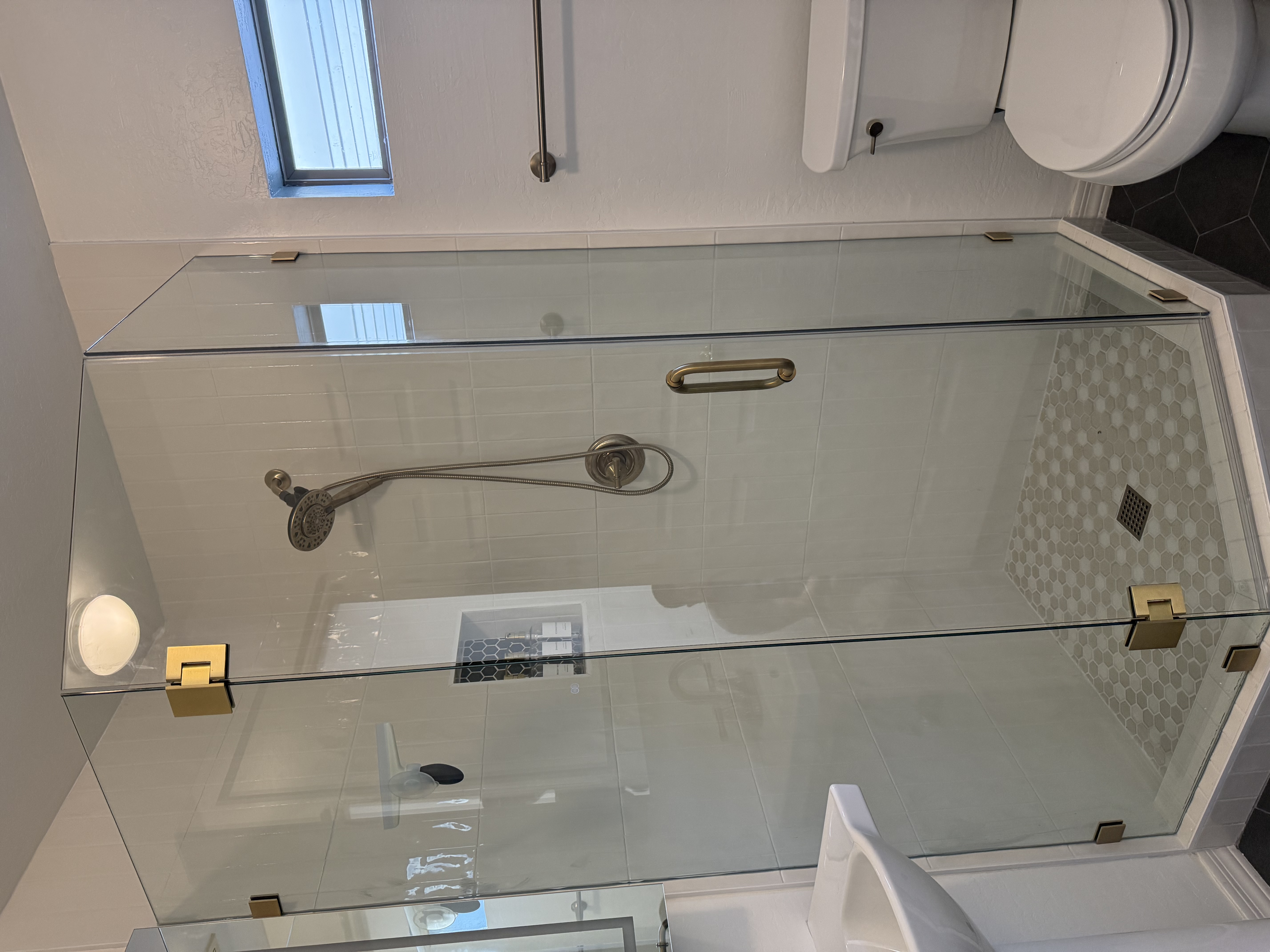
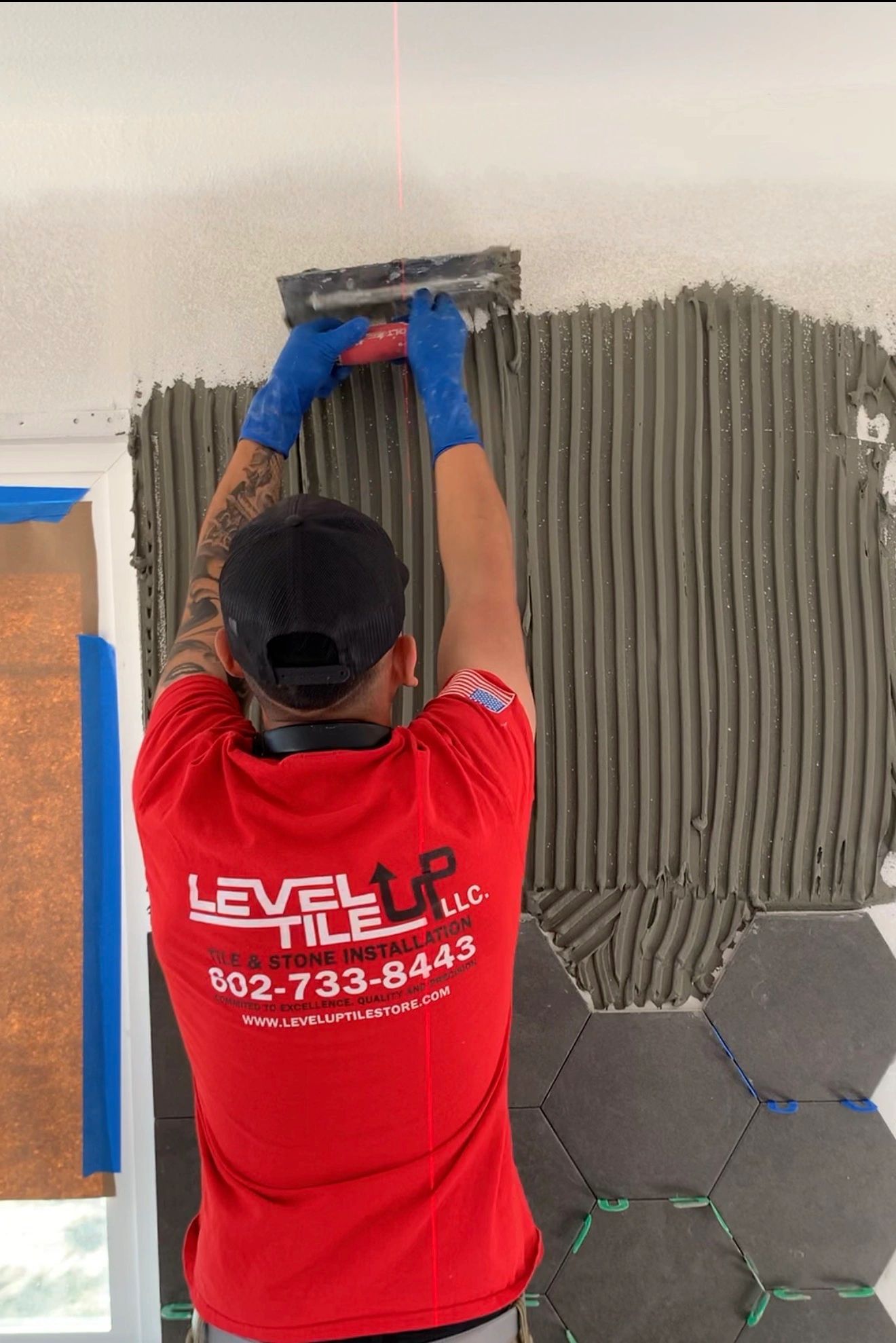
At Level Up Tile, there are no subs. Every single person on our crew is a direct hourly employee of Level Up Tile LLC. They are not paid by the job. They are not racing to finish so they can get to the next house. They are paid for their time, trained to our standards, and expected to do things right -- even when nobody is watching.
We invest in continuing education on modern installation techniques, new materials, and evolving industry standards. When Schluter releases a new membrane system, our guys learn it. When TCNA updates a specification, our guys know about it. When a new thinset or grout hits the market, we test it before we ever bring it to a client's home. This is not a crew that learned tile in 2008 and stopped paying attention.
And here is the part that matters most: if something is not right, we tear it out and redo it. Period. No negotiation. No "it is close enough." No "the homeowner will never notice." If it does not meet our standard, it comes off the wall and goes back on correctly. Our guys know that before they start. It is not a punishment -- it is the culture. Do it right, or do it again.
When you hire Level Up Tile, I am on-site. The crew you meet is the crew that does the work. And every one of them has a W-2, not a handshake deal in a parking lot.
What You Are Actually Paying For
When you hire Level Up Tile, here is what the price on that quote covers:
- A licensed, insured, bonded contractor with ROC# 349493. Real workers' compensation. Real general liability. If something goes wrong on your property, you are protected. Cash-only unlicensed contractors cannot offer you any of that.
- A full waterproofing system on every wet area, using Schluter Kerdi, HydroBlok, and FloFX. Not a coat of paint-on waterproofer over drywall.
- Real substrate preparation. Self-leveling where it is needed. Crack isolation where it is needed. Shimming and reinforcement where it is needed. Never tiled over problems.
- Premium materials, every time. No substitutions between the quote and the job site.
- TCNA-compliant installation. 95 percent thinset coverage. Proper grout joint sizing. Silicone at change of plane. Movement joints where required. Leveling system on every floor and wall.
- One crew, one project at a time. We are at your house every day until the job is done. No phantom contractors. No "I will send my guy." I am on-site.
- Clean job sites. Dust containment. Floor protection. Daily cleanup. We leave your home cleaner than we found it every evening.
- Honest communication. If something underneath is not what we expected, you will know about it before we cover it up. No surprises on the final invoice.
- A written warranty that actually means something because it is backed by an installation that followed the standards the manufacturers require for coverage.
- A finished job you will be proud to show your family and friends -- not one you will quietly keep to yourself because the corners are off or the lippage is visible.
The Real Cost of the Cheap Quote
I am going to tell you something I have seen happen too many times. A homeowner gets three quotes. Ours is in the middle or the high end. A cheaper contractor gets the job. Two to four years later, I get a phone call or a message on Instagram asking if we can look at something that "does not seem right" with a shower or a floor somebody else installed.
We go out. We see it. And almost every time it is one of three things:
- Water damage. Mold in the wall cavity. Rotting framing. Ceiling stains below. Full demolition and rebuild required.
- Cracked tile and grout. Hollow-sounding tiles. Cracks running through the field. Grout crumbling out of the joints. Either a massive repair or a total redo.
- Lippage, bad miters, and visible defects that were there from day one but the homeowner "didn't want to make a fuss about." These are the ones where the contractor was paid and is not returning calls.
And in every case, the cost to fix or redo the work is dramatically higher than the original "savings" on the cheap quote. Demolition is not free. New materials are not free. A second installation in an already-finished home is always more expensive than the first. Sometimes the ceiling below has to be opened. Sometimes there is mold remediation involved.
The math almost never works in the homeowner's favor. A $3,000 savings today turns into a $12,000 repair tomorrow -- plus the months of living around a failing bathroom before it gets torn apart again.
Please Research Us Before You Call
I am going to ask you to do something most contractors do not ask: please research us before you ever schedule a consultation.
Not because I am trying to scare off tire-kickers. Because I want to make sure our values and our approach match what you are looking for. Homeowners who go into a consultation already understanding who we are and why we do things the way we do end up having much better experiences -- and much better finished projects.
Here is what I would love for you to do before we meet:
- Read our blog. Start with Why TCNA Standards Matter and Waterproof Boards vs Cement Boards. These two posts will tell you exactly how we think about shower construction and what separates real tile work from cosmetic tile work.
- Look at our portfolio. Visit our Our Work page. Look closely at the corners, the grout lines, the miters, the niches. The details are where the quality lives.
- Read about our process. Our Process page walks through exactly what a project with us looks like, start to finish. No surprises.
- Understand our warranty. Look at the tiered coverage on our Services page. A real warranty is only possible when the installation underneath it is done to spec.
- Check our license and insurance. ROC# 349493. Pull it up on the Arizona ROC website. Verify we are current. Ask any other contractor for the same and see how the conversation goes.
- Read the reviews. Not just ours. Read reviews of other contractors too. Notice which ones have multiple complaints about cracked tile, failing grout, or water damage that appeared months after the job was done. Those patterns tell you everything.
If after all that research you feel like we are the right fit for your home, then let's talk. If you feel like we are overkill for what you need, I would rather you know that upfront than find out halfway through the project that our standards and your expectations are not aligned.
We Are Not for Everyone -- and That Is Okay
Not every homeowner wants what we offer, and that is fine. If the cheapest possible price is your only criterion, there are contractors out there who will take that job, and I hope it works out for you. Genuinely.
But if you are reading this, chances are you are not shopping on price alone. You are probably somebody who is investing in a home you plan to live in for a long time, or you are renovating to sell and you understand that inspectors and buyers can spot a bad tile job from across the room. You are probably somebody who has been burned before by a contractor who cut corners, or somebody who has heard enough stories from friends to know you do not want to become one of those stories.
If that sounds like you -- welcome. We would love to help. We will show up on time, do the work the right way, use the right materials, follow the standards, respect your home, and hand you back a finished project you will be proud of for decades.
It will not be the cheapest quote you get. It will be the last time you have to think about that tile.
Ready to Talk About Your Project the Right Way?
Once you've had a chance to look around the website, reach out for a free, no-pressure consultation. We'll come to your home, see your space, and give you one honest quote -- done to TCNA standards, with premium materials, and nothing hidden behind the tile.